
Imam Masjid Registration Form For Phase 2 Know Full Details Step By Step 2026
Imam Masjid Registration Form For Phase 2
Imam Masjid Registration Form For Phase 2 Punjab government has formally launched Imam Masjid Registration Phase 2 in 2026 to include those imams and mosques that were unintentionally left out during the first phase of the stipend program. After Phase 1, many complaints were received from different districts of Punjab, especially from rural and semi-urban areas, where documentation issues and delayed surveys prevented genuine applicants from being registered. This new phase is not a fresh scheme, but rather a corrective step to ensure that no deserving imam remains excluded due to technical or procedural mistakes.
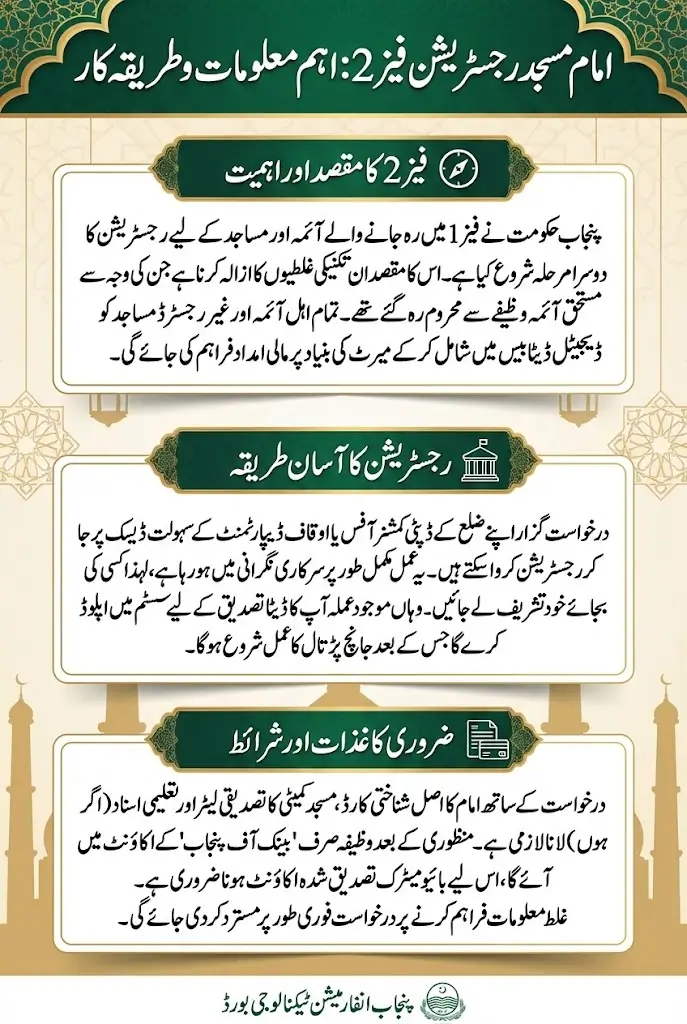
From what has been observed at the district level, many small mosques operate without formal digital records. Their imams serve regularly, lead prayers five times a day, conduct Jumu’ah sermons, and guide the community, yet they often lack proper registration documents. Phase 2 recognizes this ground reality. The government now aims to develop a verified and transparent database so that financial stipends reach the right individuals without favoritism, political influence, or administrative negligence.

This detailed guide explains the Imam Masjid Registration Form for Phase 2 in simple and clear language so that every imam, mosque committee member, and concerned citizen in Punjab can understand the process step by step.
You Can Also Read: CM Punjab Laptop Scheme 2026 Online Application
Why Imam Masjid Registration Phase 2 Was Introduced in 2026
When the first phase concluded, it became clear that the initial survey could not cover the large number of mosques functioning across Punjab. In districts with scattered villages, survey teams were unable to reach every location on time. In other cases, imams were unaware of registration deadlines or lacked guidance on documentation requirements. These gaps created dissatisfaction among communities who believed their local mosque had been ignored.
The Punjab government reviewed these complaints and acknowledged that the original records were not sufficient to ensure complete coverage. Authorities realized that many genuine religious leaders were actively serving but were excluded due to incomplete forms or missing verification. Phase 2 has therefore been designed to correct those gaps and rebuild trust in the system.
The core objectives of Phase 2 include:
- Including imams who missed registration in Phase 1
- Correcting incomplete or rejected applications
- Expanding the database of mosques in Punjab
- Strengthening verification and transparency mechanisms
- Ensuring stipends are distributed fairly and accurately
This phase reflects an effort to make the process more inclusive and structured.
You Can Also Read: Nigehban Ramzan Package Card 2026
Eligibility Criteria for Imam Masjid Registration Phase 2
Phase 2 is specifically for individuals and mosques that were left out earlier. It is not a re-registration drive for everyone, but a focused opportunity for those who could not complete the process previously. The eligibility criteria emphasize active religious service and community recognition rather than paperwork alone.
Many mosques in Punjab are built and managed by local communities without formal registration under government departments. Despite this, they function regularly and are well recognized by residents. The government has shown flexibility in considering such cases during Phase 2.
Eligible applicants include:
- Imams who were unable to apply during Phase 1
- Mosques that were not included in the initial district survey
- Applicants whose forms were rejected due to missing documents
- Private or locally managed mosques without formal registration
- Imams actively leading daily and Friday prayers
The focus remains on merit and genuine service to the community.
You Can Also Read: PSER 8070 Registration Online 2026 Punjab Online Apply
Step By Step Process to Submit Imam Masjid Registration Form 2026
The registration process under Phase 2 has been simplified compared to the earlier phase. Applicants are encouraged to directly approach official channels rather than relying on agents or unofficial sources. Deputy Commissioner offices and Auqaf Department desks are actively facilitating the process.
In practical terms, the process involves visiting the designated office, submitting relevant details, and waiting for verification. District authorities are collecting fresh data to ensure that previously excluded cases are properly reviewed. Applicants must ensure that the information they provide is complete and accurate, as incorrect entries can lead to rejection or delays.
The general procedure includes:
- Visiting the Deputy Commissioner office in your district
- Approaching the Auqaf Department facilitation desk
- Submitting imam and mosque details
- Attaching available supporting documents
- Waiting for district-level verification
- Receiving confirmation after approval
Honesty and clarity in documentation are critical for smooth processing.
You Can Also Read: How To Check Name Green Tractor Scheme Phase 3 Winner
Required Documents for Imam Masjid Registration Phase 2
Documentation is an essential part of the verification process, but authorities have shown flexibility in genuine cases. While some documents are mandatory, others are optional and help strengthen the application. Local verification by the mosque committee and community members also plays an important role.
Below is a clear overview of the required documents:
| Document | Requirement Status | Purpose |
|---|---|---|
| Imam’s CNIC | Mandatory | Identity verification |
| Mosque Committee Letter | Mandatory | Local confirmation of service |
| Madrasa Certificate | Optional | Educational qualification proof |
| Mosque Registration Proof | Optional | Legal documentation of mosque |
Applicants should provide as many supporting documents as possible. Even if optional documents are not available, strong local verification can positively influence the decision.
You Can Also Read: PSER Online Registration 2026 Again Started
Role of Deputy Commissioner Offices and Auqaf Department
Deputy Commissioner offices are at the center of Phase 2 implementation. District administrations are collecting updated data of mosques and imams who were not recorded previously. In several districts, special counters have been established to reduce confusion and long waiting times.
The Auqaf Department is also assisting in verifying religious service records and confirming mosque recognition. Elderly imams who are unfamiliar with digital systems are being guided by staff members. This coordination between departments has made the process more organized compared to Phase 1.
Applicants should remember:
- Always use official government offices for registration
- Avoid sharing personal documents with unauthorized persons
- Keep copies of all submitted forms
- Maintain contact with district officials for updates
These precautions can prevent unnecessary complications.
Digital Portal and Online Tracking System
To improve transparency and efficiency, the Punjab Information Technology Board is developing an online portal and mobile application for Imam Masjid Registration Phase 2. This digital system will reduce manual handling and allow applicants to track their status without repeated visits to offices.
The introduction of technology aims to minimize human error and improve record accuracy. Once fully operational, the portal will enable applicants to upload information directly and check verification progress.
Key advantages of the digital system include:
- Faster processing of applications
- Reduced paperwork and manual errors
- Online status tracking facility
- Improved transparency in approval stages
- Better protection of applicant data
Although physical registration remains available, digital integration will strengthen future phases of the program.
Verification and District-Level Approval Process
Every application submitted under Phase 2 undergoes review by a district-level verification committee. This multi-member committee ensures that decisions are not made by a single individual, which increases fairness and reduces bias.
The committee carefully checks the authenticity of the imam, the recognition of the mosque, and the accuracy of submitted information. In some cases, security clearance may also be required before final approval.
Verification typically includes:
- Confirming the identity of the imam
- Checking local community recognition
- Reviewing attached documents
- Validating mosque operational status
- Ensuring no duplication in records
This layered process ensures that only genuine applicants receive financial assistance.
Bank Account and Biometric Verification Requirements
Once approved, stipends are transferred directly to the imam’s account in the Bank of Punjab. Biometric verification is compulsory to prevent fraud and ensure accurate identity confirmation. Even small discrepancies between CNIC records and bank details can cause payment delays.
Applicants must ensure that their bank account is active and properly verified before expecting stipend disbursement. Completing biometric verification early can prevent unnecessary stress.
Important banking requirements include:
- Having an active Bank of Punjab account
- Completing biometric verification
- Matching CNIC details with bank records
- Updating any outdated personal information
Timely compliance with banking procedures ensures smooth payment transfer.
Complaint Procedure for Excluded Applicants
If an eligible imam believes he has been unfairly excluded, he can file a complaint through the Chief Minister’s 1717 helpline. This complaint system adds accountability and provides a formal channel for addressing grievances.
When filing a complaint, applicants should clearly explain the issue and keep a record of the complaint reference number for follow-up. This documentation helps in tracking the status of the case.
Steps to file a complaint:
- Call the 1717 helpline
- Provide CNIC and relevant details
- Clearly describe the issue
- Note down the complaint number
Following proper procedure increases the chances of resolution.




Final Thoughts
Imam Masjid Registration Phase 2 is an important corrective initiative by the Punjab government to ensure inclusivity and fairness in the stipend program. By acknowledging the gaps in Phase 1 and introducing stronger verification systems, authorities are working to rebuild confidence among religious leaders and communities.
For imams who were previously excluded, this is a valuable opportunity. Those who provide accurate information, complete documentation, and fulfill banking requirements have a strong chance of approval. Acting promptly and responsibly is essential. With proper preparation and official guidance, deserving imams across Punjab can now secure recognition and financial support under this program.